 | Click here to enter the art museum. |
This oil is one of a series of riverscapes painted in the 1990's by California artist Wayne Thiebaud (see Photograph 1).
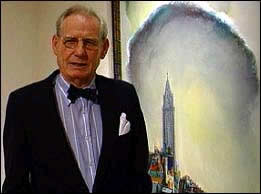
Photograph 1. Wayne Thiebaud in his sons's Campbell-Thiebaud Gallery.
Born in Mesa, Arizona, in 1920, to a devout Mormon family, Thiebaud grew up in the western United States. As a teenager in Long Beach, he worked briefly in the animation department of Walt Disney studios. After a stint in the Army Air Forces, he worked as a cartoonist and layout designer for Rexall Drugs in Los Angeles.
Encouraged by a Rexall colleague, Thiebaud left southern California and studied fine art at what was then Sacramento State College. While still a student he was offered a teaching job at Sacramento City College, where he was a member of the faculty for 10 years. In 1960, he joined the art department at the University of California, Davis.
According to art critic John Hughes: "(Thiebaud) started off in the 1960s painting gorgeously lush still lifes of kitsch diner food--everything from hot dogs to angel-food cake and gumballs (see Illustration 1). Then he turned to painting people, or rather embalming them in his characteristic thick, smooth and (when used to make flesh) slightly rubbery pigment. After moving to San Francisco in the early '70s, he took his eye outside and did cityscapes--those strange, plunging perspectives of the hills and highways of the city, translated into gravity-defying slices, with cars clinging to the asphalt like flies to a wall . . ."
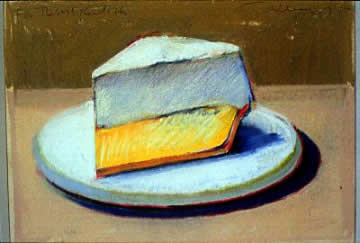
Illustration 1. Thiebaud's "Lemon Meringue Pie", 1964.
"Most recently, after a move out of San Francisco in the mid-'90s, Thiebaud embarked on a series of brightly colored, sharply divided, wildly patterned landscapes of the Sacramento River delta, seen from way up, as though from a plane--for example, River and Farms, 1996. Of his relationship to these recent riverscapes, Thiebaud said, "When I was between the ages of 10 and 13, we moved to southern Utah, to a big ranch, and did a lot of farming. I plowed, harrowed, dug and hitched up teams. I planted and harvested alfalfa, potatoes, and corn . . . and I loved it. It was a great way to grow up. These paintings have something to do with the love of the land, in some ways, the idea of replicating that experience."
Thiebaud has had several major exhibitions, including a recent retrospective which toured much of the United States before ending at New York City's Whitney Museum of American Art. At first linked with the Pop movement, over time Thiebaud has proved to be more of a traditional painter in the tradition of Jan Vermeer, Diego Velazquez and Jean Simeon Chardin. But Thiebaud's Pop image dies hard. A 2001 Time magazine article about him was titled: "The Poet of Pastry." Ironically, in the article, John Hughes argued that Thiebaud has risen above his Pop art image.
 | Source |
|---|---|
Hughes, Robert. 2001. "The Poet of Pastry", Time, July 16, pp. 66-67. |