Today from the top of these sheer canyon walls above the Colorado River,
the Hole-in-the-Rock crevice looks impassable. It is difficult to image
that in 1879 hearty Mormon pioneers blazed a trail down through this crack
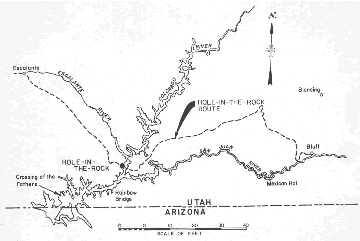
on their odyssey across southern Utah (see map below).
The Hole-in-the-Rock trail is one of the most remarkable accomplishments in the
history of the American West. It was a construction marvel carried out with
primitive tools and imaginative human labor.
The expedition was originated by leaders of the Mormon Church in 1879. The starting
point for the desert portion of their trek was the remote community of Escalante. The
mission was to colonize the rugged, remote area in what is today southeastern Utah
(the San Juan Mission). The settlers were to fortify the church's eastern flank by
establishing a buffer between discontented Native Americans and the Utah settlements.
The leaders of the mission decided to take a route which for its initial 70 miles
parallels Escalante Canyon and the Kaiparowitz Plateau. The major obstacles on the
eastward route were Glen Canyon and the Colorado River.
A preliminary scouting expedition discovered Hole-in-the-Rock, an imposing narrow
slit in the towering cliffs of white sandstone which rim Glen Canyon, and reported
that a road could be built through it and down to the Colorado River. Despite some
initial skepticism, it was decided to widen the slit and make it a portal to the
Colorado River below.
It took a month and a half of well-orchestrated effort to construct less than a
mile of trail from the canyon rim down 2000 vertical feet through Hole-in-the-Rock.
One group blasted a portion of the route while another group, dangling over the side
of the cliff, drilled holes. The latter group constructed a ledge by planting oak
poles in the man-made holes. They created a road attached to a sheer cliff.
Once the road down through the notch was completed, the descent to the river
could begin. On January 26, 1879, the wagons began their arduous descent down the
crevice. Each wagon had at least 10 men dragging on ropes and chains to keep the
wagon from careening down the crevice. Elizabeth Morris Decker, a member of the
expedition, wrote to her parents about the perilous descent:
" . . . if you ever come this way it will scare you to
death to look down. It is about a mile from the top down to the river and it
is almost straight down, the cliffs on each side are 500 feet high and there is
just room enough ro a wagon to go down. The first wagon I saw go down they put
the brake on and rough locked the hind wheels and had a big rope fastened to the
wagon and about 10 men holding back on it and then they went down like they would
smash everything. I'll never forget that day."
To commemorate the Hole-in-the-Rock expedition, Utah artist C. Roe Allman made
this dramatic pen-and-ink drawing. Mr. Allman lives in Mapleton, Utah, USA. For
years 30 years he was a civil engineer with the U.S. Bureau of Reclamation. Today,
he concentrates on his artistic endeavors. Prints of "Hole-in-the-Rock" are
available from the artist (801) 489-5256.